
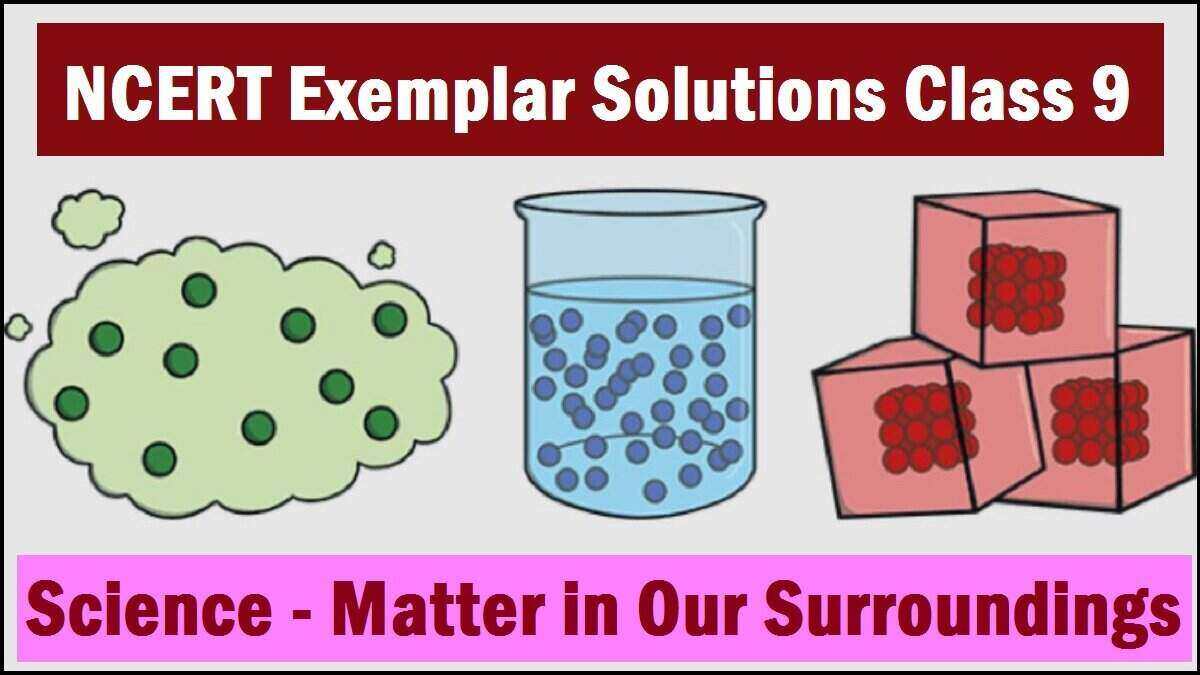
class-9th science notes chapter-1

Class 9 Science Chapter 1 Notes – Matter in Our Surroundings

​Have you ever walked into your house and immediately known that your mom was cooking your favorite pasta, even though you were still in the hallway? Or have you wondered why a drop of blue ink quickly turns a whole glass of water blue without you even stirring it?

​These everyday “mysteries” are actually our first introduction to the world of Chemistry. Everything we see, touch, or smell—from the stars in the sky to the water we drink and the air we breathe—is made up of “matter.” Simply put, matter is anything that has mass and occupies space. If it takes up room and you can weigh it, it’s matter.

​In these matter in our surroundings notes class 9, we are going to break down the microscopic world into simple ideas that will help you ace your 2026 exams.

​The Physical Nature of Matter

​If you look at a block of wood, it looks like one solid, continuous piece. But if you were to zoom in with a super-powered microscope, you’d see that it’s actually made of billions of tiny particles.

​How Tiny are These Particles?

​To give you an idea of the scale, imagine taking a single drop of water and trying to count the particles inside. You couldn’t. There are about 1.67 \times 10^{21} molecules in just one drop! These particles are small beyond our imagination.

​The Personality of Particles

​Particles aren’t just sitting there; they have specific “behaviors” that explain how the world works:

  • They have space between them: When you mix sugar into tea, the sugar seems to disappear. It doesn’t vanish; the sugar particles simply park themselves in the tiny empty spaces between the water particles.
  • They are always on the move: This is called Diffusion. Particles are restless. The smell of perfume reaches you because the scent particles are “dancing” and mixing with the air particles until they reach your nose.
  • They attract each other: Think of particles like they are holding hands. In some materials, they hold on very tight (like in a piece of iron), and in others, the grip is very weak (like in the air).

Try This at Home: Take a glass of water and add a spoon of salt. Mark the water level. Stir it until the salt dissolves. You’ll notice the water level hasn’t risen! This proves that the salt particles moved into the existing spaces between the water molecules.

​The Big Three: States of Matter

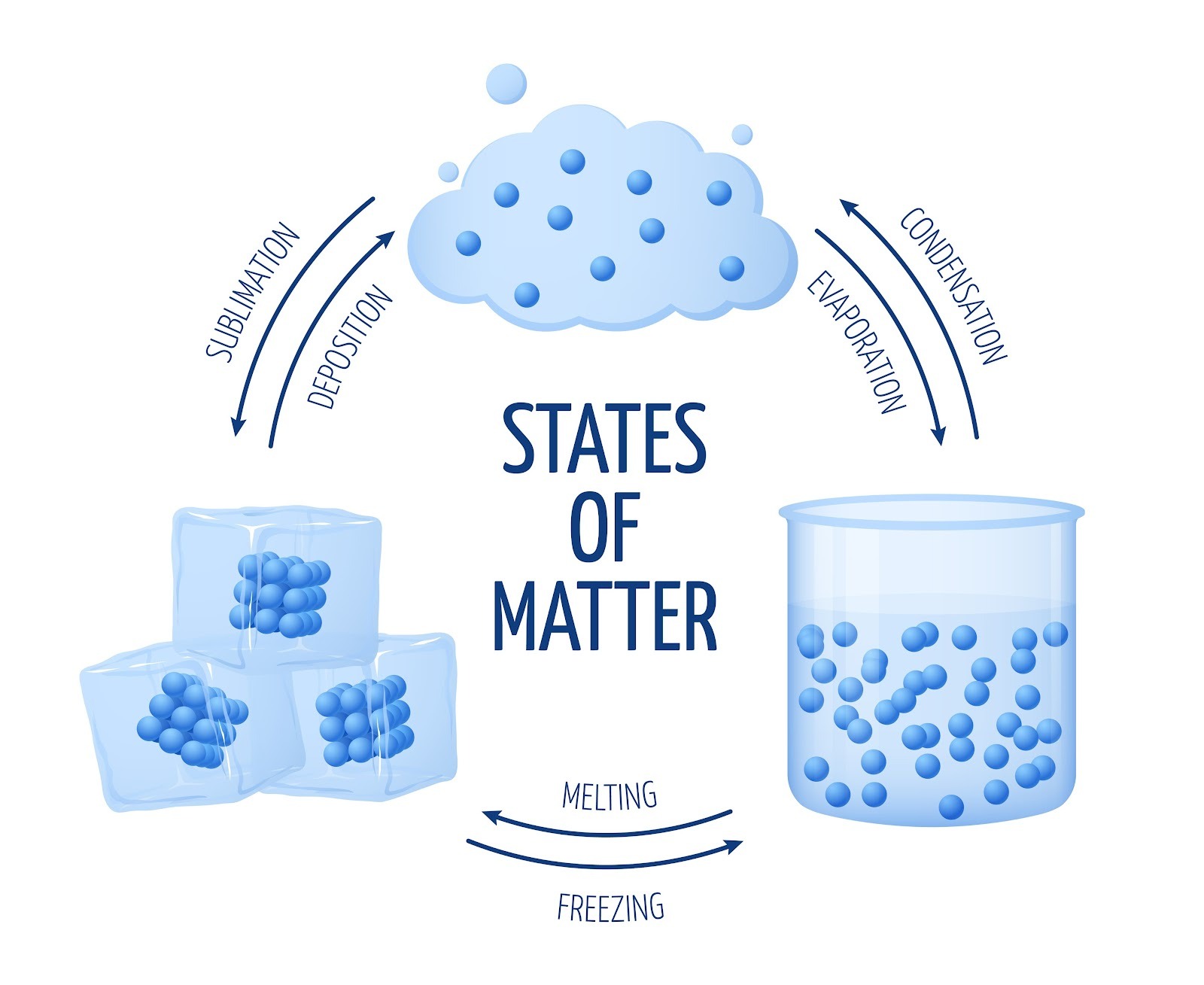
​Matter doesn’t always look the same. Depending on how close the particles are and how fast they move, we categorize matter into three main states: Solid, Liquid, and Gas.
Comparing the States

FeatureSolidsLiquidsGases
Shape & VolumeFixed shape and volume.No fixed shape (takes the shape of the container) but fixed volume.No fixed shape or volume.
CompressibilityNegligible (you can’t squeeze a stone).Very low.Highly compressible (think of CNG cylinders).
DiffusionExtremely slow.Faster than solids.Very fast (fastest).
Particle GapVery little space.Moderate

Can Matter Change its State?

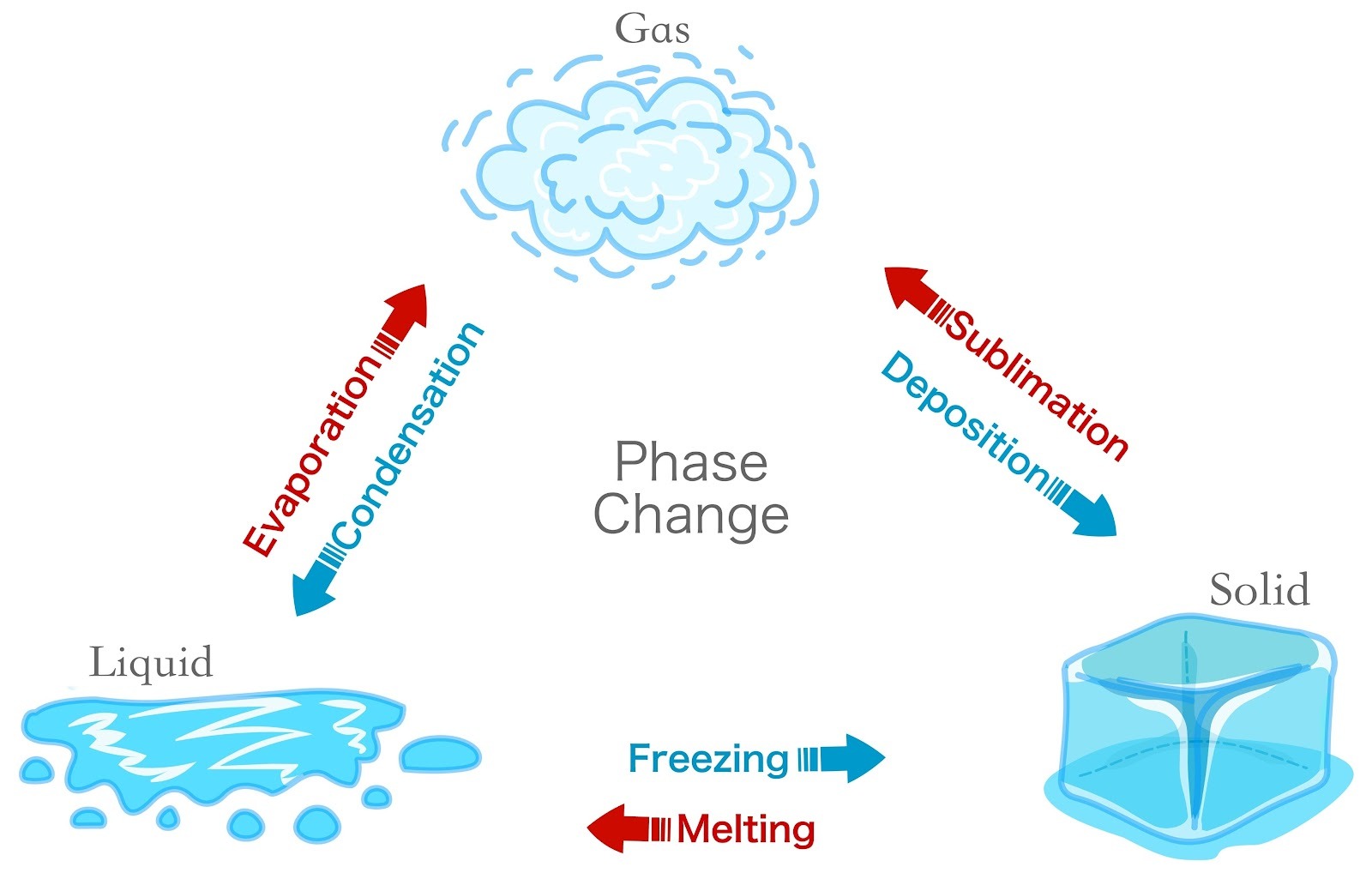
​The short answer is: Yes, absolutely. You see it every time you take an ice cube out of the freezer. Matter changes state by changing two things: Temperature or Pressure.

​1. The Power of Heat (Temperature)

​When we heat a solid, the particles start vibrating like they’ve had too much caffeine. Eventually, they break free from their fixed positions.

  • Melting (Fusion): The temperature at which a solid turns into a liquid.
  • Boiling (Vaporization): The temperature at which a liquid starts turning into a gas at atmospheric pressure.

The Mystery of “Latent Heat”

Have you noticed that when ice is melting, the temperature stays at 0°C until every bit of ice is gone, even though you’re still heating it? Where is that heat going? This is called Latent Heat (hidden heat). It’s being used to break the “hand-hold” (force of attraction) between particles rather than raising the temperature.

  • Latent Heat of Fusion: The heat needed to change 1kg of solid to liquid.
  • Latent Heat of Vaporization: The heat needed to change 1kg of liquid to gas.

​2. The Power of Squeeze (Pressure)

​If you take a gas and squeeze it (increase pressure) while cooling it down, the particles get so close that they turn into a liquid. This is how we get LPG (Liquefied Petroleum Gas) in our kitchens.

​3. Skipping Steps: Sublimation

​Some substances are “impatient.” They don’t want to become liquids.

  • Sublimation: When a solid turns directly into a gas (like Camphor or Napthalene balls).
  • Deposition: When a gas turns directly into a solid.
Evaporation: The “Cool” Concept

​Many people confuse evaporation with boiling. Boiling happens at a specific temperature (100°C for water), but evaporation happens all the time, even at room temperature. It’s a surface phenomenon where the surface particles gain enough energy to fly away.

​What makes things evaporate faster?

  • Surface Area: Clothes dry faster when spread out than when bunched up.
  • Temperature: A sunny day dries clothes faster than a cloudy one.
  • Humidity: If the air is already full of water (like on a rainy day), evaporation slows down.
  • Wind Speed: Ever notice how your hair dries faster under a fan?

​Why does Evaporation cause cooling?

​When liquid particles evaporate, they take energy from their surroundings. This leaves the surroundings cooler.

  • Earthen Pots (Matka): Water seeps through tiny pores and evaporates, keeping the water inside chilled.
  • Sweating: When we sweat, the moisture evaporates from our skin, taking body heat with it and cooling us down.
  • Cotton Clothes: We wear cotton in summer because it absorbs sweat and exposes it to the air for easy evaporation.

​Important Definitions & Units for Exams

​To score well, you need to be precise with your units.

  • Temperature Units: Scientists use Kelvin (K).
    • ​To convert Celsius to Kelvin: K = °C + 273.
    • ​Example: 0°C = 273 K.
  • Dry Ice: This is solid carbon dioxide (CO_2). It’s called “dry” because it turns directly into gas without leaving any liquid behind.
  • The “Other” States: While we focus on three, there are actually five. Plasma (found in stars and neon signs) and Bose-Einstein Condensate (created at super-low temperatures).

​Important Questions for 2026 Exams

​Based on previous years, here are the questions you should be ready for:

Q1: Why does a desert cooler cool better on a hot, dry day?

Answer: On a hot, dry day, the temperature is high and humidity is low. Both these factors increase the rate of evaporation of water, leading to a better cooling effect.

Q2: Convert 300 K to the Celsius scale.

Answer: Celsius = K – 273. So, 300 – 273 = 27°C.

Q3: Why do we feel cold when we put some acetone (nail polish remover) on our palm?

Answer: Acetone particles have a very low boiling point. They take energy from your palm to evaporate, causing your palm to feel cold.

​Summary

  • ​Matter is anything with mass and volume, made of tiny particles.
  • ​Particles are always moving and have spaces between them.
  • ​States of matter (Solid, Liquid, Gas) can be changed by temperature or pressure.
  • ​Latent heat is the “hidden” energy used to change state without changing temperature.
  • ​Evaporation is a surface process that causes a cooling effect.

​Ready to get the full version?

​If you found these notes helpful, you can grab the high-quality PDF version which includes extra diagrams and a solved question bank.

Best CBSE Class 9 Science Notes Chapter-Wise for 2026 Exam

Entering Class 9 is often a bit of a wake-up call for most students. Suddenly, “Science” isn’t just one book with easy stories; it splits into the distinct worlds of Physics, Chemistry, and Biology. It’s the year where the foundation for your Class 10 boards—and even competitive exams like JEE or NEET—is truly laid. If you get your concepts right now, the next three years become a breeze. If you don’t, it feels like a constant uphill climb.

​At Easy Study Notes, we’ve seen thousands of students struggle with bulky textbooks that use over-complicated language. That is exactly why we’ve curated these CBSE Class 9 Science Notes for the 2026 Exam. These aren’t just summaries; they are strictly aligned with the latest 2025-26 syllabus, designed to turn “I don’t get this” into “Oh, that’s actually simple!”

Stay tuned until the end to find the link to download the full PDF package for your revision.

​CBSE Class 9 Science Syllabus & Weightage 2025-26

​Before you dive into the chapters, you need a roadmap. You wouldn’t start a journey without knowing which roads are the longest, right? In Science, the “weightage” tells you where to spend most of your energy

Unit No.     Unit Name                                                            Marks

Unit I           Matter – Its Nature and Behaviour (Chemistry)     25

Unit II          Organization in the Living World (Biology)            22

Unit III         Motion, Force, and Work (Physics)                       27

Unit IV        Food Production                                                    06

Total                                                                                          80

Pro Tip: Pay extra attention to Unit III (Physics). At 27 marks, it’s the heavyweight champion of the syllabus. If you master the numericals here, you’re already ahead of the curve.

Unit 1: Matter – Its Nature and Behaviour (Chemistry)

Chemistry in Class 9 is all about zooming in. We stop looking at the world as “stuff” and start seeing it as particles.

Chapter 1: Matter in Our Surroundings

Think of matter as anything that takes up space. We explore the States of Matter—Solid, Liquid, and Gas—and how they change.

Evaporation: Why does a drop of water on a hot floor disappear? We explain the cooling effect of evaporation (the reason why earthen pots keep water cool).

Sublimation: Some things like camphor skip the liquid stage entirely and go from solid to gas. We break down these “magic” transitions.

Chapter 2: Is Matter Around Us Pure?

In the real world, “pure” means no chemicals. In Chemistry, “pure” means everything is made of the same particle.

Mixtures vs. Compounds: We use simple analogies to show why salt water is a mixture but pure salt is a compound.

Colloids & Tyndall Effect: Ever seen a beam of light through a dusty room? That’s the Tyndall effect. We explain why milk looks uniform but is actually a complex mixture.

Chapter 3: Atoms and Molecules

This is where it gets technical but fascinating. We cover the Laws of Chemical Combination—the rules that atoms must follow when they “hook up” to form molecules.

Valency: Think of valency as the “combining power” or the number of hands an atom has to hold onto others.

Chemical Formulae: We give you a step-by-step “criss-cross” method to write formulas like H_2O or Al_2O_3 without memorizing them.

Chapter 4: Structure of the Atom

If atoms are the building blocks, what’s inside the block?

Bohr’s Model: We visualize the atom like a mini solar system.

Isotopes and Isobars: Some atoms are like twins—same “name” (atomic number) but different “weight” (mass number). We explain why this matters in medicine and fuel.

Unit 2: Organization in the Living World (Biology)

Biology is the story of life. This year, we move from the “what” to the “how.”

Chapter 5: The Fundamental Unit of Life

The Cell is the hero here. Imagine a factory where every department has a job.

Cell Organelles: The Mitochondria is the power plant, the Nucleus is the CEO’s office, and the Lysosomes are the waste management crew.

Plant vs. Animal Cells: We provide a clear side-by-side comparison (like why plants need a rigid cell wall but you don’t).

Chapter 6: Tissues

Cells don’t work alone; they form teams called tissues.

Meristematic vs. Permanent Tissues: Think of Meristematic as “active” cells that never stop growing (like the tips of roots) and Permanent as cells that have “settled down” into a specific job.

Animal Tissues: We cover everything from the skin that protects you to the muscles that help you run.

Unit 3: Motion, Force, and Work (Physics)

Physics can be scary because of the math, but it’s actually just the logic of how things move.

Chapter 7: Motion

We move past just “fast and slow.”

Distance-Time Graphs: Learning to read these is like learning a new language.

Equations of Motion: We simplify the three big equations (v = u + at, etc.) so you know exactly which one to use for any numerical problem.

Chapter 8: Force and Laws of Motion

Newton’s Three Laws: From why you fly forward when a bus stops (Inertia) to why a gun recoils when fired.

Momentum: Why is it harder to stop a slow-moving truck than a fast-moving bicycle? It’s all in the momentum.

Chapter 9: Gravitation

Universal Law of Gravitation: Why the moon stays in orbit and why your pen falls to the floor.

Mass vs. Weight: One of the most common points of confusion—we explain why you weigh less on the moon even though your “mass” is the same.

Archimedes’ Principle: Why does a heavy iron ship float while a small needle sinks?

Chapter 10: Work and Energy

In Physics, “Work” isn’t just doing homework.

Kinetic & Potential Energy: The energy of motion vs. the energy of position (like a stretched rubber band).

Conservation of Energy: Energy can’t be created or destroyed; it just changes clothes!

Chapter 11: Sound

Sound is a vibration traveling through a medium.

Echo & Ultrasound: How bats “see” in the dark and how doctors look inside the body without surgery.

Unit 4: Food Production

Chapter 12: Improvement in Food Resources

With a growing population, we need smarter ways to grow food.

Crop Variety Improvement: How scientists create plants that can survive drought or pests.

Manures vs. Fertilizers: The classic debate between natural organic matter and lab-made chemicals.

Why These Are the Best Notes for 2026 Exams?

We didn’t just copy-paste the textbook. Our team at Easy Study Notes spent months refining this material to ensure it actually helps you learn.

Easy Language: We explain things as if we’re sitting right next to you. No “scientific jargon” without a clear explanation first.

Visual Aids: Science is visual. Our notes are packed with flowcharts that summarize 10 pages into one diagram.

Exam-Oriented: We’ve analyzed the last 10 years of papers. We highlight Important Previous Year Questions (PYQs) right next to the topics so you know what’s likely to show up on your paper.

Mobile-Friendly: Whether you’re on a bus or relaxing on the couch, these PDFs are optimized to look great on any screen.

Tips to Score High in Class 9 Science

Master the NCERT Diagrams: In Biology and Physics, a neat, labeled diagram can often get you 3 marks even if your explanation is short. Practice drawing the plant cell and the human ear.

The “Formula Sheet” Trick: For Physics, write every formula from Motion and Work and Energy on a single sheet of paper. Stick it on your wall. Seeing it every day makes it impossible to forget.

Practice Numericals: You can’t “read” Physics; you have to “do” it. Solve at least 5 numericals from each chapter.

Regular Revision: Don’t wait for the final exam. Use our chapter-wise notes to revise every weekend.

Conclusion

Class 9 Science is a journey of discovery. It’s the year you stop asking “what” and start asking “why.” With the right resources, this subject becomes less about memorizing and more about understanding the world around you. We are confident that these notes will be your best companion for the 2026 exams.

Believe in yourself, stay consistent, and remember—every expert was once a beginner.

Ready to Ace Your Exams?